These tours take you from Kathmandu to Chitwan National Park by tourist bus, private vehicle, or even flights, for jungle safaris featuring jeep rides, canoe trips, jungle walks, and Tharu cultural performances. Options range from a quick 1-night escape to a full 4-day safari, many with all meals, park fees, and round-trip transport included.
 Free Cancellation
 2-night, 3-day Chitwan safari with Kathmandu bus transfers, jeep safari, canoe ride, and jungle walk.
 Free Cancellation
 2, 3, or 4-day Chitwan safari from Kathmandu or Pokhara with jeep safari, canoe ride, and hotel stay.
 Free Cancellation
 3-day, 2-night Chitwan safari from Kathmandu with jeep safari, canoe ride, jungle walk, and full board.

4-day Chitwan safari from Kathmandu or Pokhara by tourist bus or private vehicle, with jeep drives, canoeing and jungle walks.
 Free Cancellation
 2-day, 1-night Chitwan safari from Kathmandu or Pokhara by shared tourist bus, with jeep safari and bird watching.
 Free Cancellation
 3-day Chitwan safari package with luxury bus transport from Kathmandu or Pokhara, all activities and meals included.
 Free Cancellation
 Two-day Chitwan trip from Kathmandu by round-trip flight, with jeep safari, canoeing, Tharu village visit and stick dance.
 Free Cancellation
 Three-day Chitwan safari from Kathmandu by private vehicle, with hotel pickup, meals, lodging, and an English-speaking jungle guide.
 Free Cancellation
 2-night safari from Kathmandu with jungle walks, canoeing, and a Tharu village visit. Breakfast included.
Read what travelers share about their experience visiting Chitwan National Park — from practical tips to personal highlights.
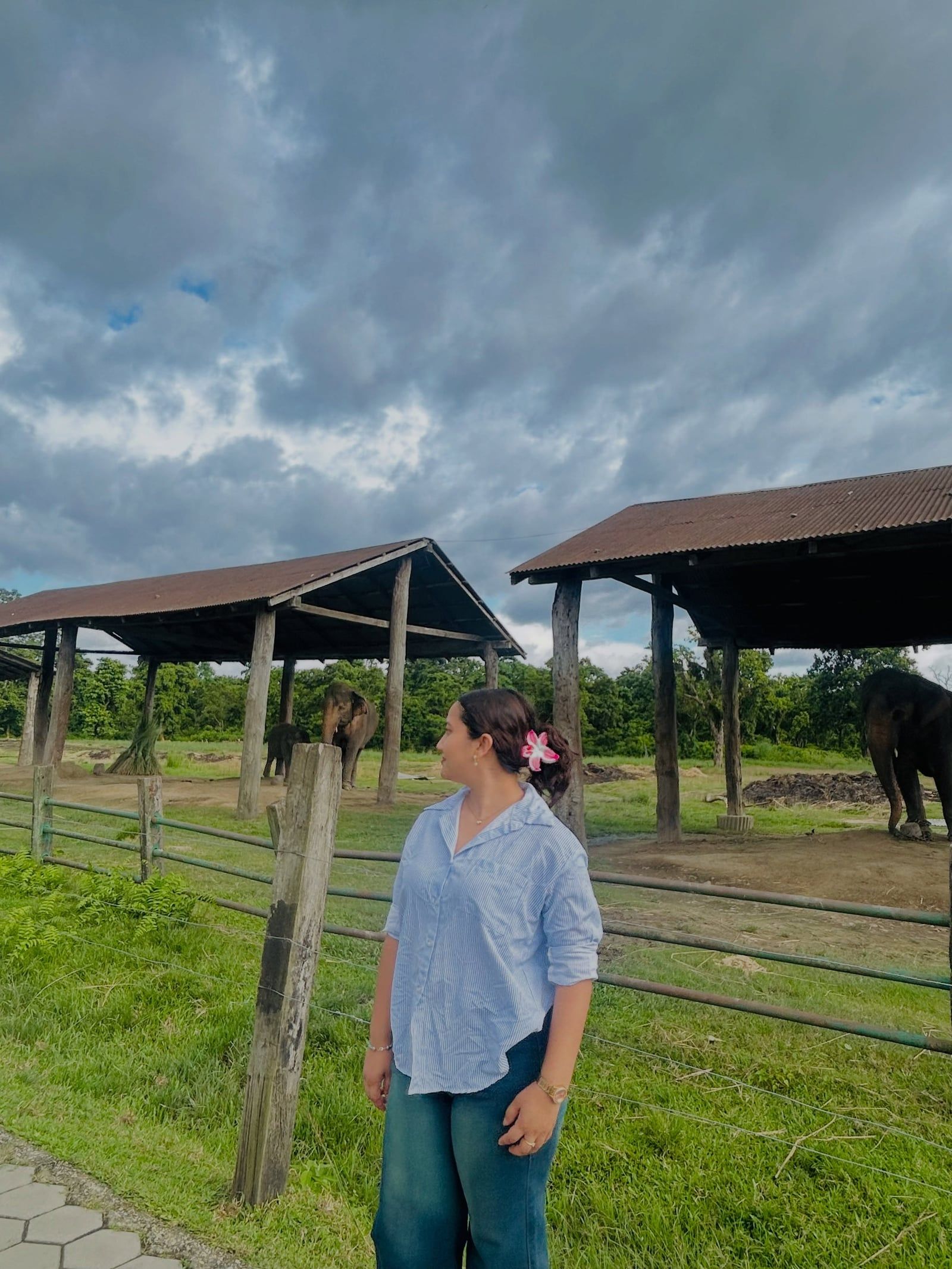
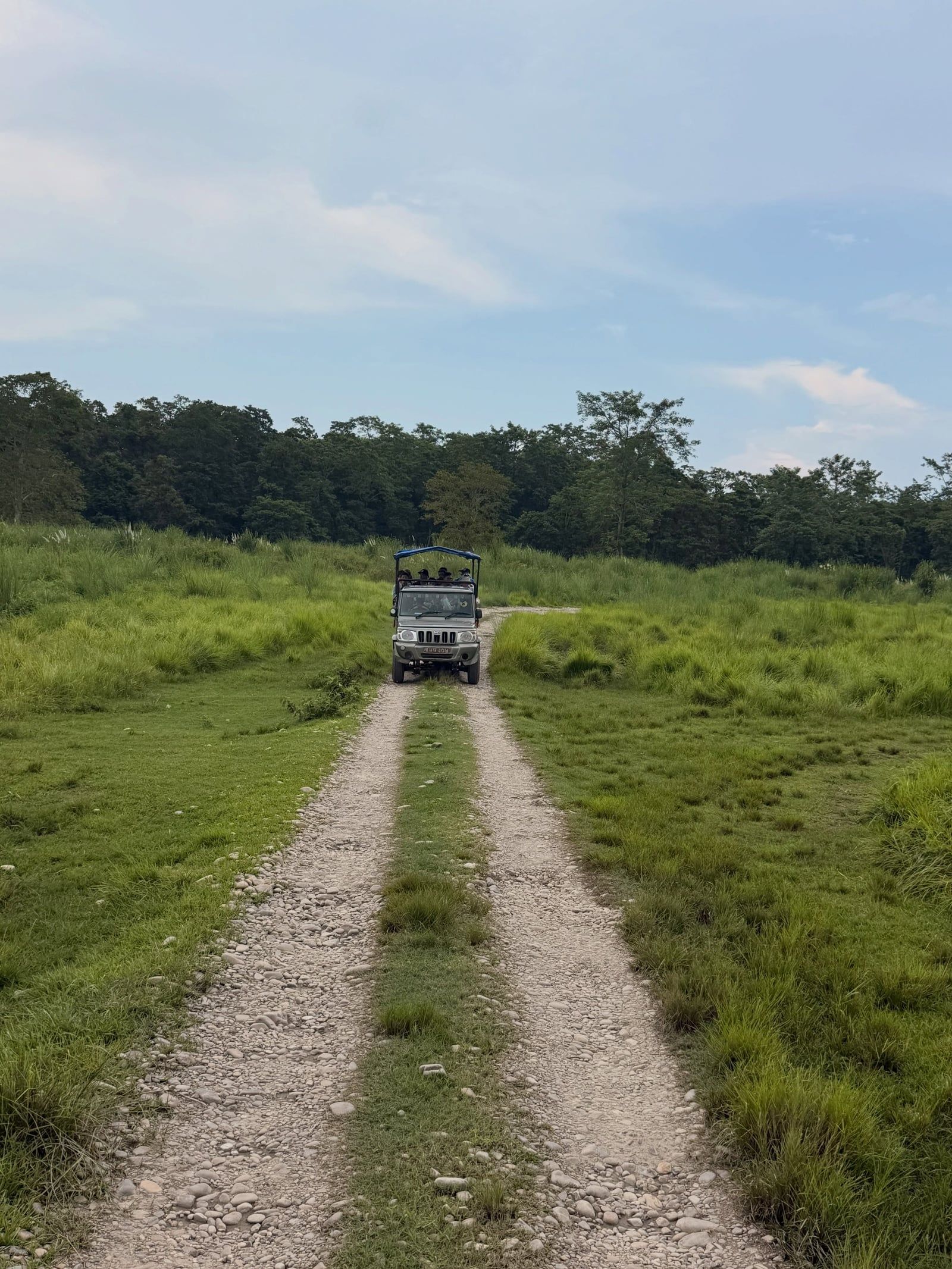
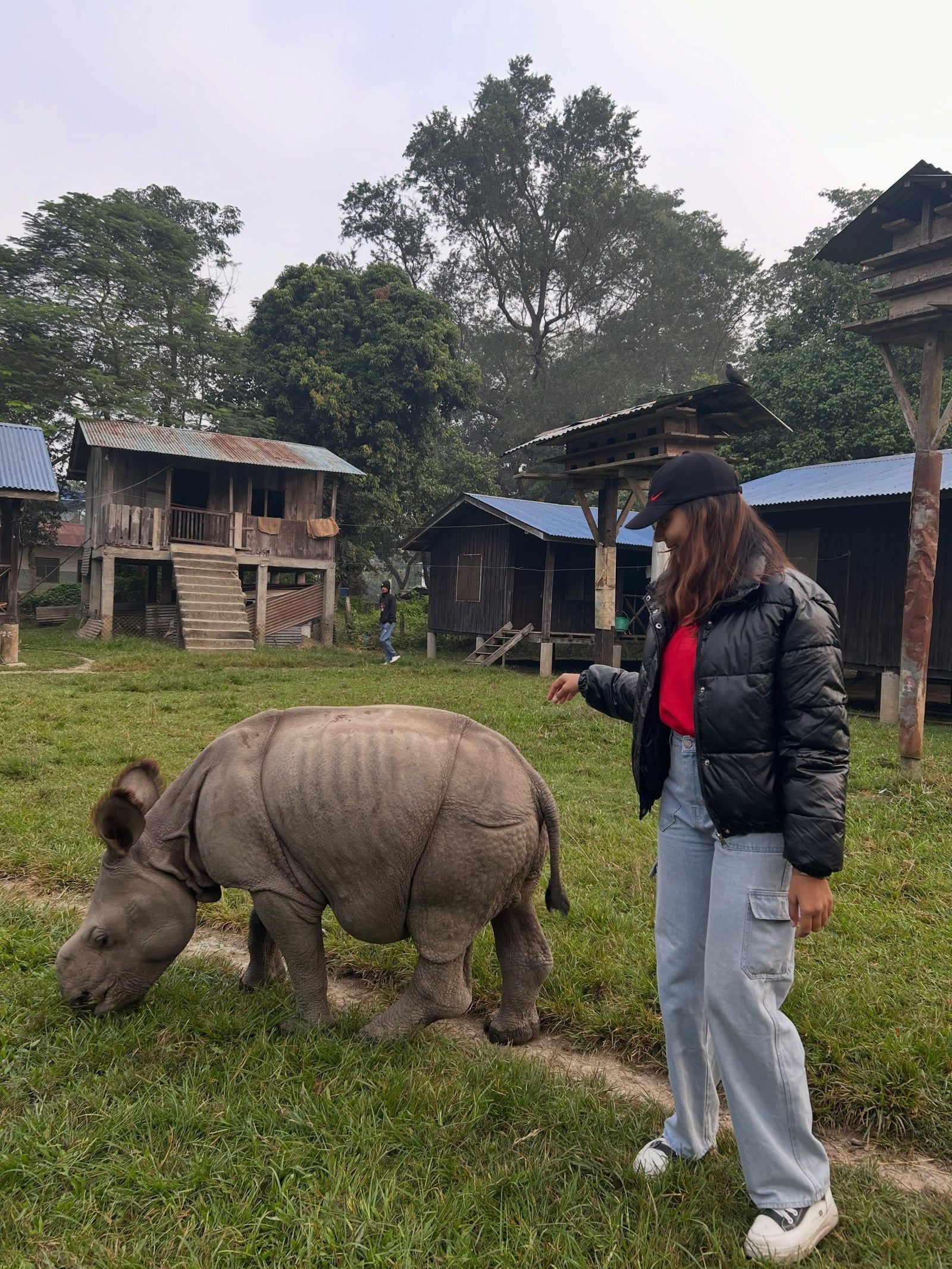
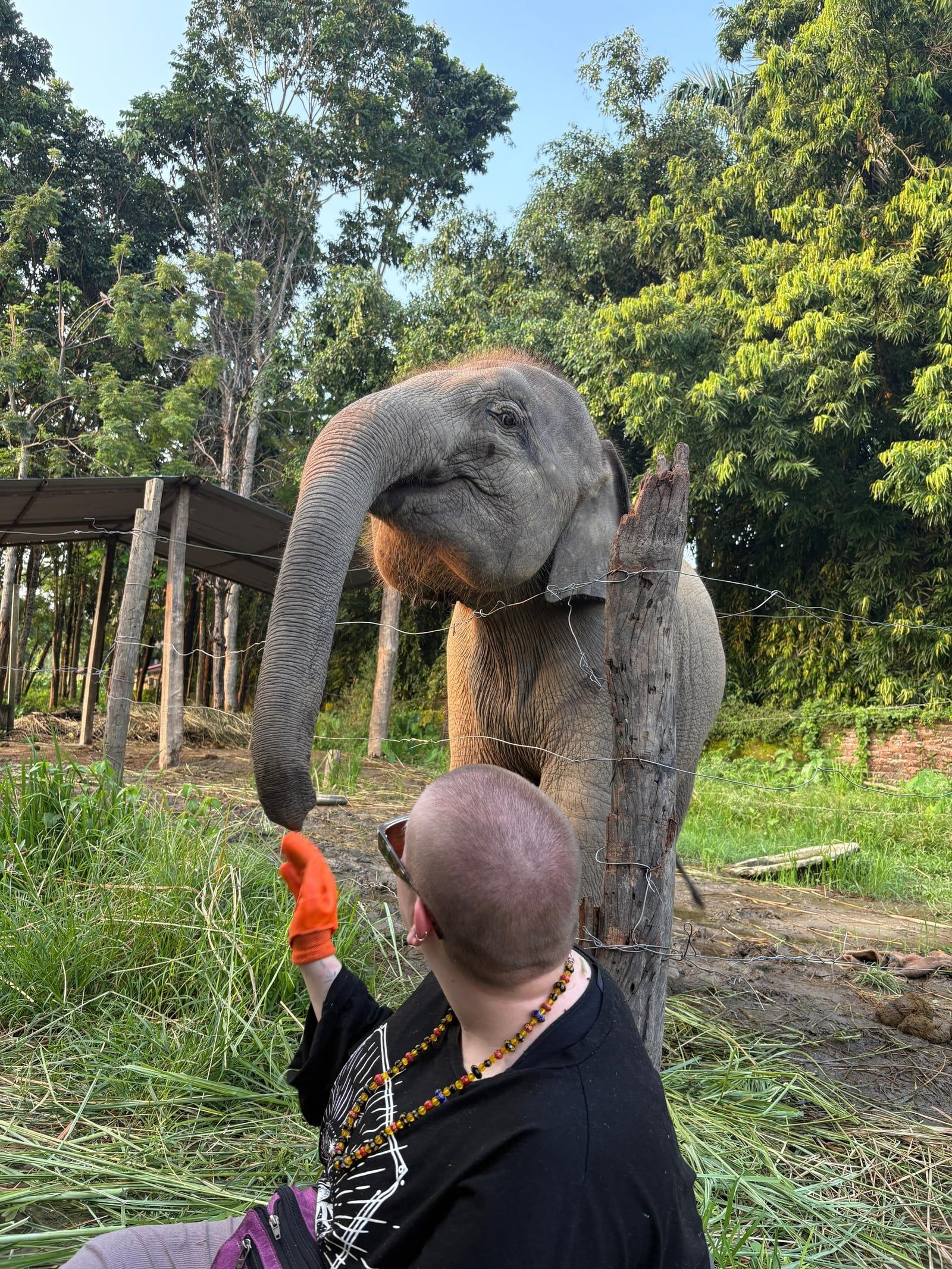
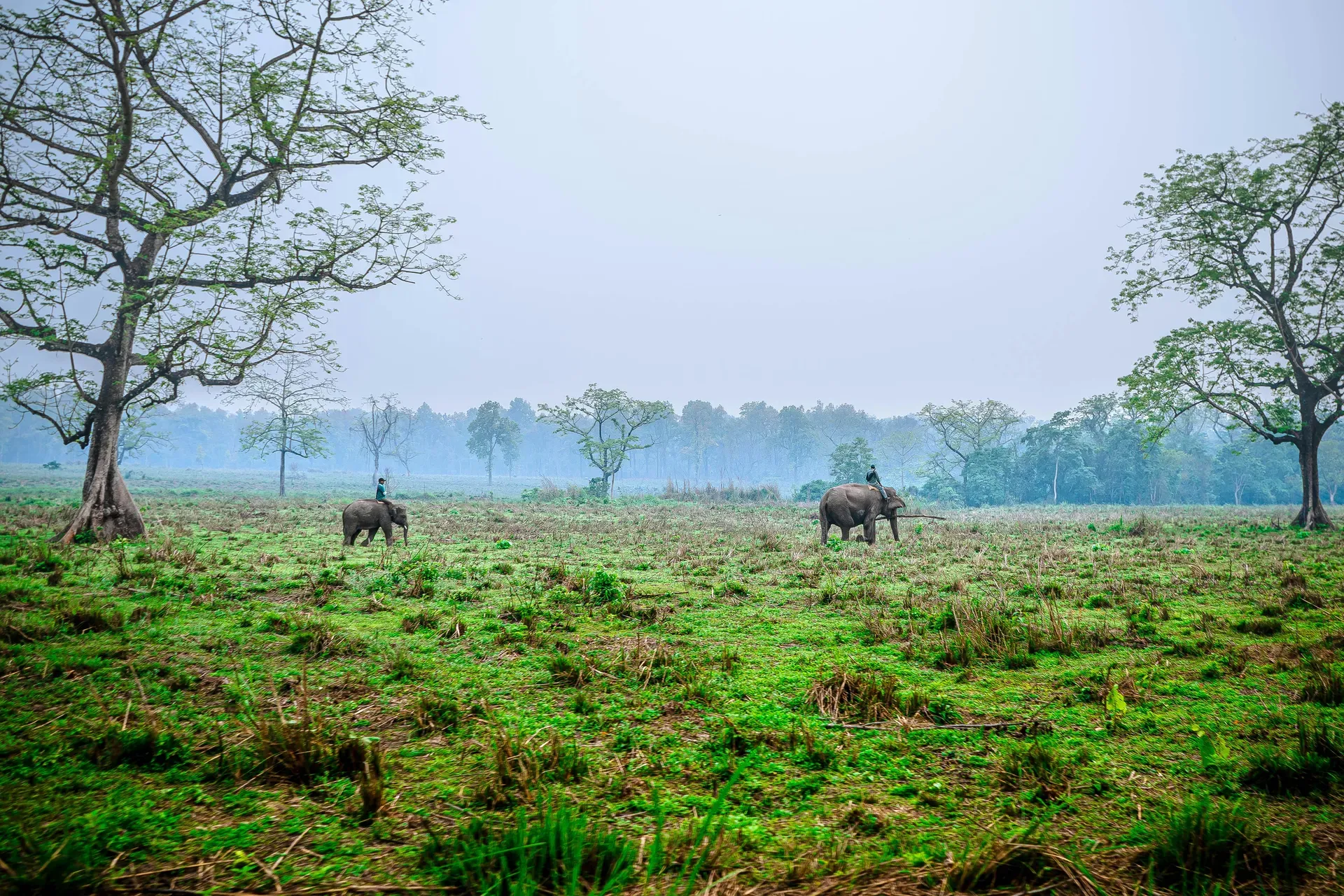
A Chitwan tour from Kathmandu swaps mountain trails for subtropical lowland: 952 sq km of sal forest and grassland, 160 km and five to seven hours down the road. Most packages follow the same 2-night, 3-day shape — bus down, jeep safari and canoe ride in the middle, Tharu cultural show in the evening, bus back. What you're really buying is a shot at 694 one-horned rhinos and, with luck, one of Nepal's 145 Bengal tigers.
Jeeps leave the Sauraha gate between 6:00 and 7:00 AM and follow the Rapti river flats, where rhinos graze at first light and sambar and spotted deer step onto the tracks. A shared half-day safari runs 4–5 hours and costs about NPR 1,250–1,900 per person. Go at dawn — that's when the animals move.
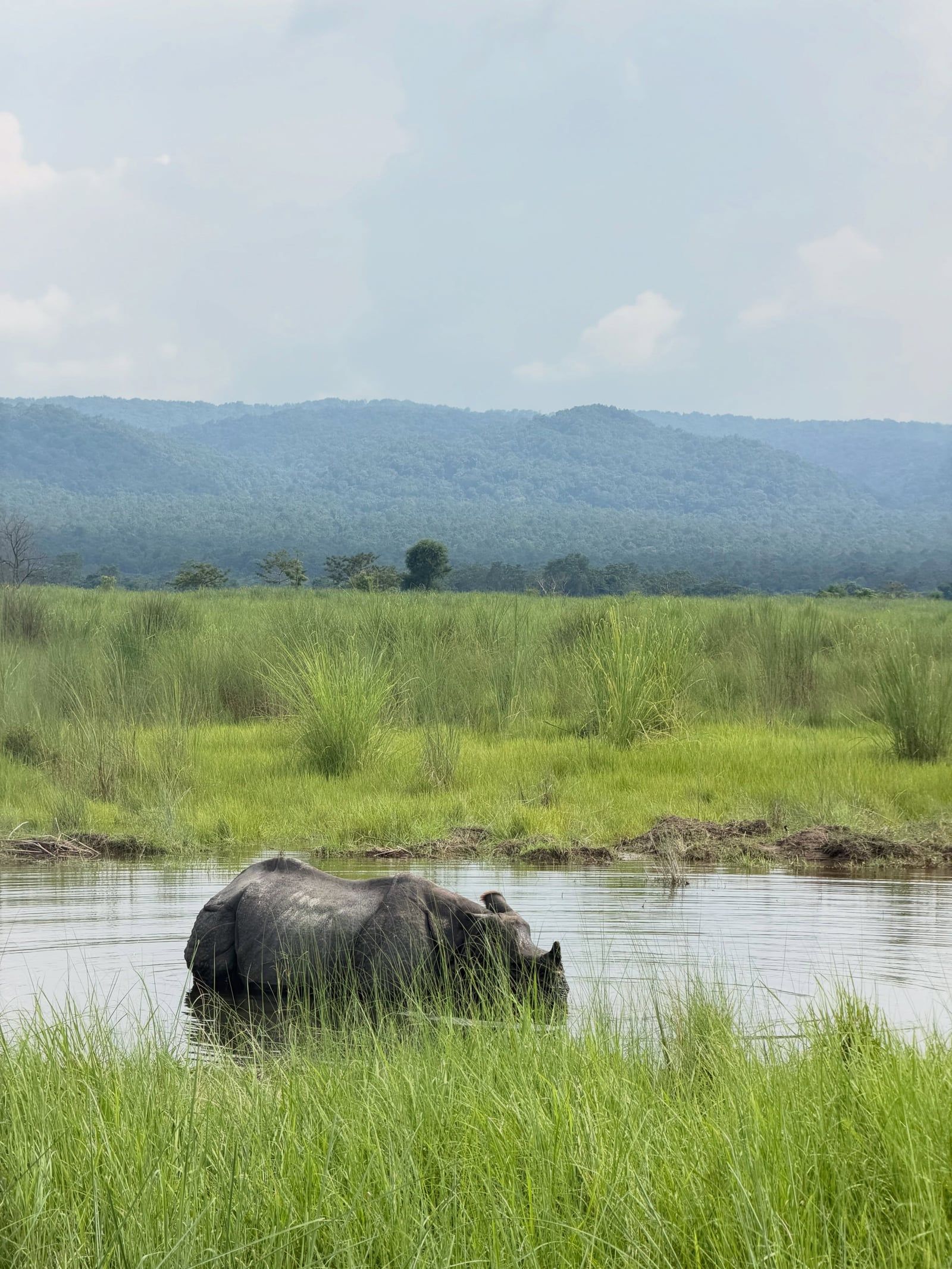
Chitwan holds 694 greater one-horned rhinos (2021 census), the world's second-largest population. You'll almost certainly see several, sometimes from a distance of a few meters from the jeep. It's the sighting that practically every visitor goes home with.
A dugout canoe drifts silently past marsh mugger crocodiles and gharials basking on the banks, with kingfishers and herons working the shallows. It runs 1–2 hours and costs NPR 1,000–1,500. Best in the dry season, when the water is calm.
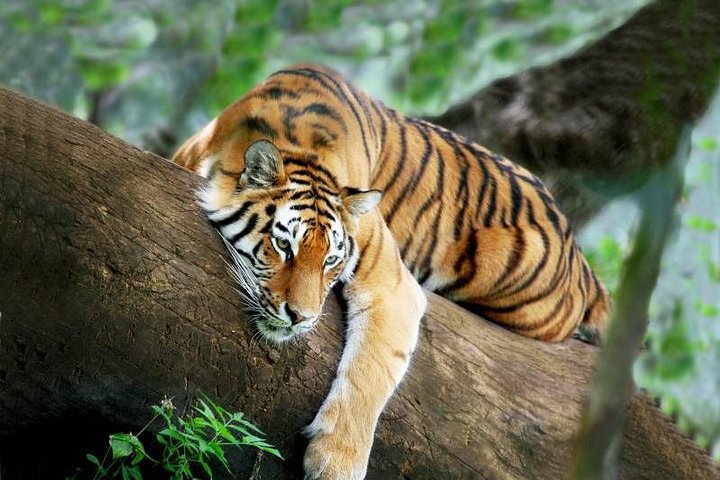
Chitwan is Nepal's tiger stronghold — 145 animals in the 2025 national census. Sightings aren't guaranteed, but dawn and dusk jeep drives past waterholes in October–March give you the realistic odds. Sloth bears and leopards show up too, less often.
Evenings in Sauraha end with stick dances and drumming by the Indigenous Tharu community, usually after sunset in village venues. It pairs naturally with a village walk past mud-and-thatch houses with painted walls, and it needs no park permit.
Chitwan is unusual in letting walkers into the core zone with licensed guides armed only with bamboo sticks. You'll find tracks, smaller wildlife, and the genuine thrill of being on foot in tiger habitat. Follow your guide's instructions exactly.
Nearly every Kathmandu-to-Chitwan package bundles bus transport, a 3-star hotel, meals, and the standard activity lineup — the differences are duration, transport mode, and how much is prepaid. Here's what to check before you pay.
All tours on this page are guided, in English, with a licensed nature guide required for any park activity — you cannot enter the core zone alone. Options run from 1 night/2 days (roughly $140) to 4 days ($299), with 2 nights/3 days the standard choice at $200–250. The 4-day version adds a night in a jungle tower.
Most listed packages cover the NRs. 2,000 foreigner entry fee, but not all do — one $252 tour lists only breakfast among its inclusions, so read the fine print. The jeep jungle-drive permit (NPR 5,000 per jeep) and guide contribution (NPR 1,000–1,500) are usually inside the package price on Viator tours, a separate charge if you book locally in Sauraha.
Book two to four weeks ahead for October–February, when safari and hotel prices run 20–30% higher and tourist buses fill up. Christmas–New Year is the tightest window. Cancellation on most packages is free up to 24 hours before departure; the 4-day tour needs 3 full days' notice or you get nothing back.
Tourist bus is the default: 5–7 hours, departures near Thamel around 6:30–9:00 AM. One 2-day package flies both ways for $647 — 25 minutes in the air on Buddha Air versus two full days of road. Private car transfers (NPR 12,000–20,000 per vehicle) can be arranged as an upgrade on several tours.
'Chitwan' can mean Sauraha, Bharatpur, Tandi, Ratnanagar or Patihani — places up to an hour apart. Confirm your stop before booking the bus. All the major tours base you in Sauraha, the tourist hub on the Rapti river.
Jeep safaris are the standard workaround for reduced mobility — no walking required, though at least one shared safari is explicitly listed as not wheelchair accessible. One 1-night/2-day tour is marked wheelchair accessible throughout. Elderly travelers do well sticking to jeeps, canoes and cultural shows, and skipping the 2–4 hour jungle walks.
Children under 10 enter the park free (carry ID), and under-5s are generally not taken on full-day safaris because of the long hours and bumpy tracks. Families do best with morning half-day safaris. Infants ride on laps on most tours.
June to September brings flooded tracks, cancelled canoe trips on the Rapti, and flash-flood risk — a past monsoon flood killed thousands of animals here. April–May works but hits 37°C. If your dates are locked to the rains, build slack into the itinerary and expect cancellations.
Swipe to see more
| Classic 3-Day Bus Package | Express 2-Day Tour | Extended 4-Day Tour | Fly-In 2-Day Tour | Private Vehicle 3-Day Tour | |
|---|---|---|---|---|---|
| Duration | 72 hours (2 nights) | 48 hours (1 night) | 96 hours (3 nights) | 48 hours (1 night) | 72 hours (2 nights) |
| Price from | US$120–250 | US$140.80 | US$299 | US$647 | US$305 |
| Best for | First-timers wanting the full standard itinerary | Travelers squeezing Chitwan between other stops | Wildlife watchers wanting a jungle tower overnight | Anyone avoiding the 5–7 hour road each way | Families and groups wanting door-to-door travel |
| Includes | Round-trip tourist bus, 3-star hotel, all meals, jeep safari, canoe ride, park entry fee, Tharu show | Shared tourist bus, private local shuttles, hotel, all meals, jeep safari, park entrance, nature guide | Tourist bus, deluxe A/C 3-star room, all meals, all permits and taxes, safari guide, jungle tower night (4-day option) | Round-trip flights, Kathmandu hotel pickup, 3-star resort, all meals, all park fees, Tharu stick dance, village tour | Private vehicle both ways, hotel pickup in Kathmandu and Chitwan, hotel, all meals, activities, dedicated safari guide |
Swipe to see more
The park operates roughly 6:00 AM to 6:00 PM daily — there is no single published gate-hour schedule, but operators consistently describe entry within this window. Walking inside the park between sunset and sunrise is prohibited outright.
Jeep safaris depart at dawn (about 6:00–7:00 AM) and again mid-afternoon. Permit counters run roughly 10:00 AM–5:00 PM; the Kathmandu permit desk at the Tourist Service Center, Bhrikutimandap, is open about 9 AM–5 PM and closed Saturdays and public holidays.
Arrange permits through your lodge or operator the evening before any morning safari — the counter won't be open early enough otherwise. Processing takes about 15 minutes.
Chitwan sits about 160 km by road from Kathmandu, in the Inner Terai lowlands of south-central Nepal.
From Pokhara it's ~150 km by bus (5–8 hours) or a 20-minute flight. Don't schedule a safari the same day you arrive after the long road journey — most tours correctly leave it for day two.
October to March is the window. Days run 21–29°C, nights drop to about 8°C in December, and the post-monsoon grass is short enough that animals are visible as they concentrate at waterholes.
October–February is also peak season: expect crowds and prices 20–30% higher, worst around Christmas–New Year.
April–May is workable but hot — up to 37°C in May. Skip June–September entirely if you can: July alone sees about 24 rain days, jeep tracks flood, Rapti canoe trips stop for high water, and the region is prone to flash floods.
Most visitors stay 2 nights/3 days: village walk and cultural show on arrival day, jeep safari plus canoe the next morning, birdwatching before departure. A half-day shared jeep safari lasts 4–5 hours; a full day runs 7–10.
The park core is not wheelchair-friendly: tracks are rough dirt, safari means an open 4x4 jeep, and at least one shared safari is explicitly listed as not wheelchair accessible. One 1-night/2-day tour package is marked wheelchair accessible throughout.
Jeep safaris are the standard workaround for reduced mobility — no walking required, minimal physical demand. There are no ramps or paved trails at the gates; arrange private transfers and hotel assistance in advance.
Elderly visitors manage well with jeeps, canoe trips and cultural shows, and skip the jungle walks (2–4 hours on foot through tall grass). Half-day morning safaris beat full-day ones on rough tracks. Children under 10 enter free; under-5s generally aren't taken on full-day safaris.
Sauraha, on the Rapti river, is the tourist base: lodges, 3-star hotels (most tours house you here), restaurants, and bicycle rental at about NPR 500 a day. Roads from Sauraha to the park gates take 10–20 minutes.
Official sites inside and around the park include the Gharial Breeding Center at Kasara (founded 1978 with Frankfurt Zoological Society support, with hatchling pools) and the Elephant Breeding Center at Khorsor. Kasara also holds the park headquarters museum.
In the buffer zone, Beeshazari Tal — a 32 sq km Ramsar-listed oxbow-lake system about 12 km from Sauraha — is free of jeep queues and excellent for birds, crocodiles and the occasional rhino. Facilities at the gates themselves are basic; carry your own water and snacks.
Entry fee: NRs. 2,000 per person per entry for foreigners (NRs. 1,000 SAARC, NRs. 150 Nepali, under-10s free), paid at the gates or in advance at the Tourist Service Center, Bhrikutimandap, Kathmandu. The fee is charged per day — a second day inside means a new permit. A jeep jungle-drive permit costs NPR 5,000 per jeep on top.
Mandatory guide: every core-zone visit requires a licensed guide through a registered operator. No walking between sunset and sunrise. Guides carry only bamboo sticks — no firearms.
Prohibited: drones (extra written permission needed), smoking or fires inside the park, feeding or baiting wildlife, plastic waste, and buying any animal or plant products — that last one is a prosecutable offence. Wear dull colors and skip perfume on safari.
This is serious: 11 people died and 41 were injured in animal attacks in Chitwan district in 2024–25, mostly rhino charges. Follow guide instructions instantly.
The road distance is about 160 km. Tourist buses take 5–7 hours and depart near Thamel between 6:30 and 9:00 AM; private cars take 4–6 hours and cost NPR 12,000–20,000+ per vehicle. The fastest option is a 25-minute Buddha Air flight to Bharatpur, followed by a 30–45 minute transfer of 18 km to Sauraha.
Booked tours on this page run from about $120 for a 3-day luxury-bus package to $647 for a 2-day fly-in version, with the standard 2-night/3-day bus package around $200–250 including hotel, meals, park fees and activities. Booking locally in Sauraha is cheaper but piecemeal: NPR 2,000 entry, NPR 1,250–1,900 shared jeep, NPR 1,000–1,500 guide and NPR 1,000–1,500 canoe — roughly NPR 5,250–6,900 in activities plus VAT.
Most packages list the National Park fee among inclusions — the $200 3-day tour and the $299 4-day tour both cover it. Check before booking: some list only vague 'activities' or, in one case, just breakfast. If it's excluded, foreigners pay NRs. 2,000 per person per entry, and the fee is charged again for each additional day inside the park.
Possible, not guaranteed. Chitwan holds 145 Bengal tigers (2025 national census, Nepal's largest population), and dawn or dusk jeep drives past waterholes between October and March give the best odds. Rhinos are the reliable sighting — 694 live in the park — and most visitors see several without trying.
It's tight but workable. A 1-night/2-day package covers a jeep safari and a canoe ride, but with 5–7 hours of road each way you get roughly one full day of activities. Most tours and the parks' own standard itinerary recommend 2 nights/3 days, which fits the jeep safari, canoe, jungle walk and Tharu cultural show without rushing.
Most tours on this page offer a full refund if you cancel at least 24 hours before departure. The 4-day tour is stricter: you need to cancel 3 full days ahead or you get 0% back. Check the policy on your specific booking before relying on it.
Yes — you cannot enter the core zone alone. Every visit requires a park entry permit plus a licensed guide arranged through your lodge or a registered operator, usually booked the evening before. Permits take about 15 minutes to process at the gate or at the NTB Tourist Service Center in Kathmandu.
October to March. Days run 21–29°C, tracks are dry, and short grass plus animals gathering at waterholes makes wildlife easier to spot. Avoid June–September, when monsoon flooding restricts jeep tracks, cancels canoe trips on the Rapti and brings flash-flood risk; April–May is tolerable but hits 37°C.
Jeep safaris suit all ages, and children under 10 enter the park free. Under-5s are generally not taken on full-day safaris — families prefer morning half-day tours. Elderly visitors do best with jeeps, canoe rides and cultural shows, and skip the jungle walks, which mean 2–4 hours on foot through tall grass in tiger habitat.
No malaria cases are reported from the park itself, and one travel-medicine clinic advises bite precautions only, without prophylaxis, for short visits. But Australia's Smartraveller lists malaria and dengue as risks in the Terai, so use repellent, long sleeves and screened rooms, and ask your doctor about prophylaxis and the Japanese encephalitis vaccine before you go.
Browse verified tours with free cancellation and instant confirmation.
Find Tours


Two nights, three days, with round-trip tourist bus between Kathmandu and Chitwan already in the price. The package runs through the park's standard activities: jeep safari, canoe ride, jungle walk, a village tour, and a Tharu culture dance show. Park entry fee is covered, and so are all meals at the lodge — breakfast, lunch, and dinner each day. The safari goes well inside the park, where the realistic sightings are one-horned rhinos (Nepal has around 650) and, if you're lucky, one of the country's roughly 198 Royal Bengal tigers. Guides work in English. Pickup is flexible: you choose your own point anywhere in Kathmandu, Lalitpur, Bhaktapur, or Pokhara, and the operator collects you from there. Cancel at least 24 hours before departure for a full refund. Anything beyond the listed inclusions — drinks, extras — you pay for on the spot.
For a full refund, cancel at least 24 hours before the scheduled departure time.
English


Pick a 2, 3, or 4-day run, starting from either Kathmandu or Pokhara. Every option includes a jeep safari and a canoe ride in the park, a 3-star hotel in Chitwan, all main meals (breakfast, lunch, dinner), an English-speaking nature guide, and a Tharu cultural program. The 4-day version adds a night in a jungle tower inside the park — you sleep there and wake up inside the reserve rather than back at the hotel. Transport differs by length. On the 2-day option you get a private vehicle door-to-door, straight to Chitwan. The 3- and 4-day travelers come down on a tourist coach instead. So if a private ride matters to you, the short trip is the one that has it. Be in your hotel lobby or at your apartment's main entrance five minutes before pickup; the driver meets you there. Cancel at least 24 hours before departure for a full refund.
For a full refund, cancel at least 24 hours before the scheduled departure time.
English


Two nights, three days, and everything booked for you: this tour leaves Kathmandu by tourist bus to Sauraha, runs the safari program, then returns you by bus to Kathmandu — or drops you toward Pokhara if that's your next stop. Days are built around the park's standard activities: a jeep safari drive, a canoe ride, and a jungle walk, all with a professional English-speaking guide and national park fees already paid. Evenings end with a walk down to Sauraha beach for the sunset. The price covers all three meals, two nights in a 3-star hotel, hotel pickup and drop-off within Chitwan, and pickup from any hotel in Kathmandu on departure day. Gratuities are the only extra. Cancel at least 24 hours before departure for a full refund.
For a full refund, cancel at least 24 hours before the scheduled departure time.
English


Four days in Chitwan, travelling from Kathmandu or Pokhara by tourist bus or private vehicle, with pickups limited to inside Kathmandu city or the Lakeside area of Pokhara. Bus passengers make their own way to the departure point — Sorhakhutte Tourist Bus Stop in Kathmandu or the Tourist Bus Park at Lakeside, Pokhara — and vouchers arrive closer to the tour date. Activities inside the park run with an experienced English-speaking safari guide: jeep drives with a maximum of 10 people per jeep, guided jungle walks, and canoeing along the river for bird watching. Outside the park, the tour adds a guided Tharu village visit, a Tharu cultural show, and a sunset viewpoint over the park. Three nights go in a 3-star hotel in a deluxe A/C room, with all meals covered — breakfast, lunch and dinner throughout the stay. Park permits, conservation fees, government tax and the tourist service charge are included; gratuities are not. Cancel at least 3 full days before departure for a full refund — inside 3 days, there's no refund.
If you cancel at least 3 full day(s) before the scheduled departure time, you will receive a full refund.<br>If you cancel within 3 day(s) of the scheduled departure, you will receive a 0% refund.
English


This is the shortest practical version of a Chitwan safari: one night, two days, starting from either Kathmandu or Pokhara. Round-trip transport is by shared tourist bus, and once you're there, all local shuttling runs in a private vehicle. The two activities on the itinerary are a jeep safari and bird watching. The package covers the hotel night, plus dinner, breakfast, and lunch — so every meal on the trip is included. The national park entrance fee is in the price, and an English-speaking nature guide accompanies the jungle activities. Anything beyond the listed items (drinks, extras, personal expenses) is on you. Cancellation terms are standard: a full refund if you cancel at least 24 hours before departure. Two days is tight for Chitwan — you get the core jeep safari and birding, but there's no slack day for a second activity if weather or luck goes against you.
For a full refund, cancel at least 24 hours before the scheduled departure time.
English


Three days and two nights, starting with a 5-6 hour ride from Kathmandu (or Pokhara) to Sauraha on a tourist luxury bus with AC, reclining seats and onboard refreshments. You get an e-ticket with boarding time, seat number, bus operator contact and pickup/drop points. Your base is an AC resort in Sauraha. Activities run with an English- or Hindi-speaking trained naturalist: jeep safaris, guided nature walks, and canoe rides on the Rapti River where crocodiles and waterbirds congregate. A Tharu village visit and dance performance are part of the package, not an add-on. Tigers are occasionally seen, rhinos more reliably — jeep safaris give the better odds of both. Included: park entrance fees, all government and local taxes, all jungle activities, the naturalist guide, accommodation, breakfast, lunch and dinner. Land transport both directions is covered. Cancel at least 24 hours before departure for a full refund.
For a full refund, cancel at least 24 hours before the scheduled departure time.
Hindi, English


This 48-hour tour runs from Kathmandu on round-trip flights — no long bus ride down the Terai. Pickup and drop-off are included from hotels inside Kathmandu, and a guide leads the trip in English. The package covers all national park and entrance fees, plus meals (breakfast, lunch, dinner) and a night in a 3-star property such as Park Safari Resort or Chitwan Paradise Hotel, on a twin/double sharing basis; solo travelers get a single room. Jungle activities include a jeep safari, bird watching and canoe riding, plus a cultural tour to a Tharu village and an evening Tharu stick dance performance. Cancel at least 24 hours before departure for a full refund.
For a full refund, cancel at least 24 hours before the scheduled departure time.
English


This tour runs three days door to door, with round-trip transport from Kathmandu by private vehicle. Pickup covers hotels inside the Kathmandu ring road — if you're staying outside it, arrange a meeting point with the operator in advance. A jungle safari guide accompanies the activities throughout the trip, in English. Lodging is on a twin/double sharing basis, with a single room provided for solo travelers. Breakfast, lunch, and dinner are all included, along with the safari activities as per the itinerary. Park entry fees and drinks aren't listed as included, so budget for those separately. You can cancel for a full refund up to 24 hours before departure. Wildlife sightings are never guaranteed — rhinos, deer, and monkeys are common, but a tiger sighting is rare luck.
For a full refund, cancel at least 24 hours before the scheduled departure time.
English


Three days and two nights, starting with airport pickup in Kathmandu: a representative waits at the arrival hall exit holding a 'Trek with Trust' placard and helps with luggage before the drive out. An English-speaking guide runs the trip throughout. Days are built around guided jungle activities and a canoe ride on the park's rivers, taken at a relaxed pace rather than a rushed checklist. Time is also set aside for a visit with the local Tharu community. Breakfast is included; other meals are on you. Cancel at least 24 hours before departure for a full refund.
For a full refund, cancel at least 24 hours before the scheduled departure time.
English